Thursday, March 13, 2014

David Herrle Enraptures Us With "Sharon Tate And The Daughters Of Joy."


Lovers of poetry may know David Herrle for his book, Abyssinia, Jill Rush and his popular ezine SubtleTea. Now he's here to discuss his new book, which blends poetry with prose, Sharon Tate And The Daughters Of Joy. We're joined by a dear friend who actually introduced me to David's work years ago, poet and author Collin Kelley.

Collin Kelley: In one sentence describe this new collection.
 
David Herrle: I haven’t a short wind in my body, but, aside from being bubblegum self-psychoanalysis, the book is an aphoristic odyssey through aesthetics, art, beauty, sexuality, atrocity, mortality and salvation contextualized by the grisly dooms of Queen Marie Antoinette, Ripper-victim Mary Jane Kelly and Sharon Tate. 
 
Mme. Perry: The reader is guided in an orderly manner into some shocking, sharply defined and richly pigmented places from Invocation to Sermon to Benediction. How did you determine the order of the book? 

DH: Early on the book was intended to be about only Sharon Tate and the Mansons, but the more I wrote the less important they became.  The butchery at the Polanski home on that doomful night on August 9, 1969 seemed to be more of a culmination or a logical fruit of some of the universal concerns I was having.  That’s why I pushed the Tate/Manson part to the end.  Since I think the murders had something to do with what I call the War on Beauty, I decided to start the book with spiels on aesthetics and art (Reverse Galatea).  In hyperbolic, Decadent fashion beauty is praised above all else, echoing Dostoyevsky’s love for Shakespeare and Raphael over the serfs’ freedom and even one’s entire nation.
Author David Herrle
Of course, not far from such lofty things lurk human crustaceans’ envy and rage, mutilating tantrums and the mob’s tendency to pull down mountains and replace them with molehills, so the part about the French Revolution (Saint Guillotine) followed naturally.  Opponents of the death penalty beheaded the king and queen (and many, many other folks); humanitarians spilled blood with glee.  From there I widened the scope of atrocious behavior, including the advent of the Bomb, and explored the anxiety over death and need for a genuine lifeline from existential despair (Black Dahlia Nihilismus).  The illusory salvation of the lofty and beautiful is exposed, as is the pent rage, the will to power and the latent Caligulas in so many disgruntled artists.  Beauty and art can’t save us. 

Neither can sex.  The next part (The Pink Cathedral) deals with sex, lust, the glory and degradation of bodies, pornography, even the problematic cuteness of Eva Braun (who married one of history’s biggest death-dealers). 

Of course, death is never far from sex.  Thanatos and Eros are first-cousins.  This lead me to Jack the Ripper, the killer of whores (Yours Truly, Mathematicus).  However, I consider this phenomenon to be more about victim Mary Jane Kelly than the Ripper himself.  This is the opposite of the Sharon Tate thing, which is more about the Mansons than the gorgeous central victim.  Peacenik hippies stabbed those people to meaty pulp.  While Charlie was recording songs in Beach Boy Dennis Wilson’s studio his harmless nonsense lyrics “digh de day” eventually turned into “die today.”  Do the math.  So the slaughter of Tate and her friends closes the book (Charlie Manson and the Scorpion Children). 

Those six parts served as a nice white for the hardboiled egg, but the shell and yolk were missing.  That’s why I designed the introductory Evocation, the Sermon interlude and the ultimate Benediction. 
Actress Sharon Tate
CK: I don't think Sharon Tate gets the pop culture reverence she deserves. What fascinates you about Tate and her legacy? 
 
DH: Indeed.  For all of her beauty’s fame and the infamy of her violent doom, Sharon isn’t really on the tip of the cultural tongue, especially among later generations.  She should be.  And, sadly, I think she should be less sung for her actual achievements and more for her being an unfortunate symbol of the victimization of the lofty and beautiful done by lowlifes, artists-become-tyrants, the deranged spiral of the utopian spirit.  It’s infuriating but understandable that Charlie Manson is a household name and a presence – even inspiration! – in pop culture.  He’s up there with Mao and Che. 

Despite my sympathy and desire for vengeance for Sharon, I can’t say that I’ve ever been very impressed with her profession as an actor, although she’s absolutely dazzling in movies such as The Wrecking Crew, Valley of the Dolls and The Fearless Vampire Killers.  She was an Earth angel, an aesthetic phenomenon, what I call a Reverse Galatea: sacralized beauty, gorgeous body turned into inspiring sculpture.  I suspect that she was viewed and treated this way by many – if not most – people, maybe including her husband, even though she also was a delightful, sharp, conflicted, emotional, thoughtful human being (think Marilyn Monroe).  For this reason I minimized her voice and focus in the book.  Even the hero who saves her (in what one reviewer called “a noir superhero ending ...a dreamlike divine comedy”) can muster only “Big fan, Sharon” as she kisses him in thanks.  Oops.  Spoiler!

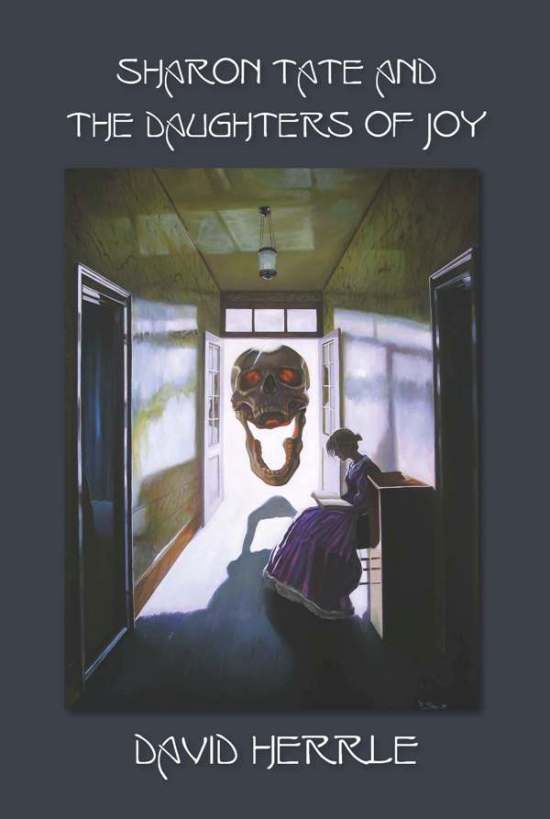
MP: Artist David Van Gough, whose work The Valley is the cover art for the book, said “I make no bones when I say that I believe Herrle’s work is as profound as Ginsberg's Howl and every bit the master painter with epigrams.” What was your reaction on reading that? 

DH: Needless to say, I was quite honored.  Though I dislike Ginsberg’s work, I recognize his talent and the artistic importance of what he did.  The compliment was meant as a high one, and I take it as such, especially since it comes from an astute, clever and masterful artist.  Gough’s necrorealism made me rethink my aversion to so-called macabre art, and he’s become a treasured colleague.
Author/Poet Collin Kelley

CK: If you were a member of the Manson Family, what would your nickname be?

DH: A wicked challenge.  Part of me doesn’t want to even consider it due to the despisal I have for the Mansons.  Another part sees the humor in it.  Also, nicknames factor heavily in my book.  The narrator takes on the titles Scarlet Pimpernel, Sophie Scholl, The White Rose, Davidus Thermidor, Thermidorean Gray, History’s Etch-A-Sketch.  Manson-girl Susan Atkins named her son Zezose Zadfrack Glutz, which I guiltily find hilarious, so I’ll lighten up and choose Robin Hood Goodfellow – or Havelock Ellison.

We wish you much success with Sharon Tate And The Daughters Of Joy, David, and invite you to return very soon.
Herrle at the start of his literary career.

And of course, it's always wonderful to be with our friend Collin Kelley, my partner in many adventures and a favorite here in the salon.

You can get your copy of Sharon Tate And The Daughters of Joy, follow on Facebook, and subscribe to SubtleTea.
 

Wednesday, March 12, 2014

Thursday, February 20, 2014

"Holy Toledo And The Virgin Shirley" Is An Intoxicating Literary Romp Crafted & Served By Robert Leland Taylor.


Welcome again to Madame Perry's Salon. It delights me to introduce a guest who may be new to you. The eclectic, artsy hamlet of Zanesville, Ohio is the home of artist and author Robert Leland Taylor.  

Most of you are fans of my co-interviewer, Grant Jerkins, author of A Very Simple Crime, The Ninth Step, and At The End Of The Road. Although many people, including author Kerry Dunn, author and publisher Sheryl Dunn, and myself encourage Taylor to get his work to the public, I believe it was Jerkins who gave him that last push off the ledge. So to speak. And away we go.


Grant Jerkins: What genre does Holy Toledo and the Virgin Shirley fit into? In a typical bookstore, in what section should your novel be shelved?

Robert Leland Taylor: I'll take any shelf—just get me in there. But if I had to choose, I'm torn between Humor and Sci-fi. Like most writers, successful or struggling, I hate being categorized at all. A large table at the very front of the store would do nicely.
GJ: What kind of people read your books? Who is the average Robert Leland Taylor reader? What do they look like?

RLT: Well, I hope my work appeals to a broad audience, although my protagonists are generally quite young. Sometimes I picture my nine readers that way—young, bewildered and slightly demented.
Madame Perry: To my delight I found Holy Toledo and the Virgin Shirley shared many of the qualities I love in Kurt Vonnegut’s novels. Your use of dark humor, satire and science fiction was a surprise at first, but I wasted no time in strapping on the seatbelt for the ride. Are you a Vonnegut fan?


Robert Leland Taylor

RLT: Huge Vonnegut fan. I was drawn to his unconventional style, humor, and shared many of his sentiments regarding our priorities here on the planet, although I certainly didn't share his genius in expressing them. Early on I made a conscious effort to avoid mimicking him, realizing that a Vonnegut wannabe would garner about as much acclaim as an Elvis impersonator. Speaking of which—before Elvis' career took off, a music producer asked him who he sounded like. “I don't sound like nobody,” he said. That's my goal, too—I don't wanna write like nobody.
Grant Jerkins
GJ: I know you’re a painter, and I have to say I’m quite taken with the images you create. There is a wistful, forlorn quality to your art. Loneliness is prominent. Isolation. Often, human figures are absent, and when they are included, they are typically dwarfed by landscape and structures—sometimes at the expense of scale. Your novels, however, have more humor and are first and foremost about people. You could even say the people in your fiction exert themselves over structures and institutions. They triumph, whereas the people in your paintings succumb. I wonder if you are driving at the same truth with both forms, or is there a dichotomy there?

 
RLT: Wow. I've never had my work analyzed with such depth and detail. There is a sadness to existence, and it succeeds in breaking through in our lives, no matter how hard we try to keep it at bay with humor, art, literature and any other earthly distraction we can conjure. For me, sadness is a natural state, and any interruption to that state, no matter how brief, is euphoric and very much worthwhile. My sad paintings may reflect the reality of life, and the humorous writing could very well represent the way I wish things were. Bullshit? Probably. But it's true to me.
MP: What authors, or artists, do you feel had the greatest effect and influence on you and your work?

"Regrets" by Robert Leland Taylor
RLT: Well, I can tell you which author inspired me to start writing—Shephard Mead. The novel was called The Carefully Considered Rape of the World, a sci-fi. I was below drinking age at the time, which helped considerably with comprehension and the motor skills required to turn pages. I devoured the novel, wrote one just like it—or similar to it, only not as good—called Where Dead People Go. It sucked big-time and remains somewhere in my closet with three other big-time stinkaroos from the learning days. (Although one of them won an honorable mention somewhere but please don't make me look it up)

MP: Is there a certain music you enjoy while writing, or a preferred place in which to write?


RLT: I can work anywhere, but pretty much prefer a quiet atmosphere where I can hear the voices in my head. I've written at my place of employment before, scribbling on a clipboard while pretending to attend to some work-related matter of great importance.

GJ: Nathan, the protagonist in HolyToledo and the Virgin Shirley, has a universal appeal. He’s an everyman. Befuddled but smart. Simultaneously weak and strong. He doesn't entirely understand the world around him, but it’s a world that doesn't make much sense. Still, he does the best he can with it. Are there aspects of you reflected in Nathan?

RLT: Yeah, quite a bit, actually. And I'm assuming those characteristics pertain to most in the everyman category. I suspect that I'm similar to my protagonists in a number of ways, but quietly pray that I'm wrong.

GJ: Can you tell us a little about your vestigial twin?

RLT: Well, as you know, I try to keep that part of my life private, but thanks for asking. Trebor and I get along much better these days and no longer entertain thoughts of a surgical separation. Doctors deem the operation too dangerous, and even if it were successful, Trebor would have a difficult road ahead, being only eleven inches tall when removed from my abdomen. Sure, we still argue on the bus at times, but Trebor (that's Robert spelled backward, for those who don't know) is a huge, necessary part of me.

MP: I think I hear Trebor now, which means it's time for your ride back to Zville. We wish you much success, and look forward to your next book, A Sunday Afternoon Stroll Through The Ant Farm. Thank you, Robert, for sharing time with us. I love your FaceBook and Twitter posts more than you can imagine. Thanks also to you, Grant, and I hope you will have time to visit again very soon.
 
RLT: Thanks for inviting me to Madame Perry's, and it's great to see Grant Jerkins here. I've been a big fan and admirer of your work for several years now. (Looks around) Wow, it


looks like the inside of Jeannie's bottle in here. Nice. Smells like Lysol and vanilla—not the artificial kind, but the real stuff from beans. At least I think vanilla comes from beans, doesn't it? Not the artificial kind, but the...never mind.
 
MP: I am delighted to have both of you here, Robert and Grant, and I wish you both much success as even more people discover your books. Grant, I look forward to another visit from you soon as well!

Please follow Robert L. Taylor on FaceBook and Twitter. You can get the Holy Toledo And The Virgin Shirley on Amazon. You may leave questions for either of these gentlemen in the comments section.


Tuesday, October 22, 2013

Wesley Cook - It's You (Official Music Video)


Madame Perry regrets neglecting you all for so long. I have more exciting guests and discussions coming soon. For now, let me make it up to you with the very fine Wesley Cook and the official video of his new song "It's You."

You can also visit Wesley's website or follow him on Twitter. He's constantly on tour and will be in your area soon.


Thursday, September 5, 2013

Byron's review of Forevermore


Byron is actually a very astute book reviewer. Enjoy his review of "Forevermore" by Jim Musgrave!

Tuesday, June 11, 2013

Author Jim Musgrave Introduces Patrick O'Malley, The Star Of His Newest Mystery Series


Welcome, dear friends. Please pour a cup of tea or an apperitif as I introduce you to an author with many books to his credit already, yet has a newly launched mystery series set in the late 19th century. The stories in this entrancing series are told by Irish detective and war hero Patrick O'Malley, and are deftly woven into actual events of the time.

We are joined by a dear friend of our salon, author, poet and playwright Collin Kelley.

MP: Jim, I am delighted to have you as a guest here in Madame Perry’s Salon along with my good friend Collin Kelley. Tell us how you created the character of Detective Patrick O’Malley.

JM: I used my subconscious. I didn’t realize until after I’d completed the first mystery, Forevermore, that I had been channeling a character very similar to Lawrence Block’s famous sleuth and recovering alkie, Matt Scudder. I even had a partner for Pat O’Malley who was a hooker madame (sorry for the reference, Madame Perry), the same as Matt Scudder had a high class call girl in modern-day New York. Of course, they are completely different characters in completely different times, but I was quite astonished when I realized there were some basic similarities between them.

CK: What drew you to write about this time period?


Jim Musgrave
Edgar Allan Poe
JM: This Victorian period was probably the most criminal time in the history of New York City. Did you know, for example, that the age of consent in the 1860s was 10? Ten-year-old children were being offered to the highest bidders for sexual favors in the second most profitable business in the city (the garment industry was #1). My third mystery in the series, by the way, will have Becky Charming warring with the infamous Madame, Jane the Grabber (Hester Jane Haskins), over this issue. You see, Becky is a high class Madame (like you, Jennifer!), and she’s a Vassar graduate, so she wants to shut-down this Grabber woman, even if what Haskins is doing is condoned by the corrupt city officials of The Ring (Tammany Hall). O’Malley and his partner want to find a way to get her put out of business forever. I love this era because it’s so corrupt and freewheeling in a lot of ways. It’s a perfect fit for a detective like O’Malley, who’s seen the worst of human nature while fighting in the Civil War. Like today’s veterans who become police officers when they return from Afghanistan (another “civil war”?), O’Malley is little bit PTSD and a little bit hero.
Hester Jane Haskins
aka Jane The Grabber

MP: In Forevermore, the first book in your series featuring Pat O’Malley, he investigates the mysterious death of his friend Edgar Allan Poe. How long did you spend researching the life of Poe and the times he lived in to create this intriguing story?

CK: What other books were your inspirations?

JM: I hate confessing this because I am a teacher, but I used to ditch my high school English class to go read Poe in the library. He wasn’t taught, so he was my first “forbidden fruit.” I found a great web site called “The Edgar Allan Poe Society,” and it provided me with all I ever needed to know about Poe. I simply had to weave it into my plot and my character, O’Malley, and I was off to the storyland races! 

Collin, I guess Block’s style influence me, although I obviously had to adapt the jargon for my time period. I was also influenced by reading a lot of James Patterson (short, impacting chapters!) and Thomas Harris (how intelligent a villain can be!). Also, I was re-reading Robert Bloch’s Psycho the other night. That’s a great lesson in compact storytelling that grips you on the page.

MP: Every interesting protagonist or hero has a quirky flaw to overcome. O’Malley’s challenge is intimacy with the ladies, though oddly enough his most trusted friends are the women of the brothels. Please tell us how you conceived the idea for this aspect of our Irish detective.

JM: I took a graduate English course on the Transcendentalists. Since Becky Charming is a Vassar grad, she is able to teach O’Malley how to use his feminine, intuitive nature to connect with what Emerson called the Over Soul. As soon as he “gets it,” he can get it (on with Becky) and then solve his case! What a hero!
 
MP:  Indeed! Thank you for graciously visiting my salon, and I look forward to your return with more fascination tales from dear Mr. O'Malley.
Collin Kelley
 
CK:  Jim, I wish you much success with Forevermore and look forward to the next books in the Pat O'Malley series.


Now for the information you need to shadow Detective Patrick O'Malley and Jim Musgrave, get Forevermore on Amazon,  and follow Jim on Twitter. Care to step back in time to 1860 when you're in a waiting room, riding the subway, or just have some time to kill, shall we say? Our dear author has created an app so your getaway is in your pocket when needed!

Collin Kelley's latest book of poetry, Render, is available on Amazon and bringing in great reviews! He'll be back soon to discuss it with us.

Remember, my dear friends, surrounding ourselves with good books, music, food and wonderful people is a gift of love to all. And as always, your comments or questions are welcomed.

Tuesday, February 19, 2013

British Humorist Carol E. Wyer Is The Pick-Me-Up We've Needed!

Are you familiar with author Carol E. Wyer? The USA is sadly lagging behind the UK and Europe in their love of this lady. Wyer has been referred to as BOTUK, meaning she's the Erma Bombeck Of The UK. She lists among her favorite quotes "You can't succeed at everything in life, but you can laugh at everything." Anonymous

Fortunately I came to be a fan of hers through another of Madame Perry's favorite writers, Sylvia Massara. If you are a reader of both of these proficient and savvy authors you'll see they are allowing some of their characters out to play in each other's books. I suppose they are like literary exchange students. I am very pleased to introduce you to Carol E. Wyer.

Madame Perry: How did you know the blog style of novel would work so beautifully?

Carol: It took a lot of research to discover that Mme Perry. I knew absolutely nothing about blogging when I decided to write the book. I wanted to write it as a diary but I thought that format had been done far too often. One night, while in bed listening to the dulcet tones of Hubby snoring, I realised that in this day and age a woman like Amanda/me would socialise on the internet. That could be the answer. I Googled “blogs”, and read quite a few of them. That made me decide I could present the whole story through blog posts.
Carol E. Wyer

Next, I set up my own blog, called it Facing 50 with Humour, (just like Amanda does) and started writing about my life in the form of funny diary entries. By the end of six weeks, I had quite a few followers who commented regularly, much like Amanda’s followers. They gave me such fantastic feedback that I realised I had found a great format for the book.

I started the novel but also kept my blog. I won’t spoil the end of the book, but in one of those cases of life imitating art, I found myself in exactly the same situation as Amanda. I even found a new on line best friend - a follower much like #sexyfitchick - who has become a dear friend of mine since. 

 
MP: What has been your favorite reaction from a fan?

CEW: I have had the most incredible emails from people who have thanked me for making them laugh, but one that touched me the most came from a lady who said simply that she had lost her best friend to cancer the morning she picked up my book. She didn’t know why she had picked up the book, because she hadn’t intended reading it, but after starting it, she couldn’t put it down. She believed she was meant to read it that day. She told me that it saw her through that saddest time and helped her deal with the loss. In spite of how bad she felt, the book made her laugh. She believed, as do I, that laughter can really help. I was so humbled by that email. I still have it filed on my computer. I keep them all. They are the real reward that a writer gets for writing.
 

MP: Amanda is being courted online by her first love. Without giving away too much of the story, do your readers offer their opinions on what choices they prefer Amanda should make?
CEW: Those who have spoken about it have assured me that Amanda made the right choice. I have to say that several women have also confided that they have found themselves in exactly that position. There are a surprising number of women who are engaging in on line flirtation or something more meaningful.
 

MP: I’m sure thousands of your readers are as happy as I am to read an engaging book with an intriguing romantic story line appealing to us gals ‘over 30.’

CEW: Thank you. I am very glad that you enjoyed it so much. It means a huge amount to me when people tell me that they have liked my book.  I was delighted when one reviewer said that I had done for the over 40s, what Bridget Jones had done for the over 20s. That was a lady who “got” the story. There is not enough “fun” literature available for women of a certain age that deals with emotions that have, like us, also matured. I can’t read chick lit any more. I feel like tutting with disapproval at some of the things young girls do or say, but I have not dried up emotionally and enjoy books with relevant content, that is, relative to someone who has already had a long term relationship.

At the same time I decided to write humour. Humour works well when you want to educate someone, or get a point across. I also believe that life is too serious for most of us these days and we need to be able to sit down and read something that will have us chortling. I wanted the book to be like a friend. I want people to read it and say, “Yes, that’s me. I am like that.”
 

MP: What writers inspire you?

CEW: I studied French and English Literature at University and was heavily into Chaucer, Voltaire and Shakespeare, so if I am honest, those are the people that I have been most inspired by.

More recently, I have enjoyed literature by humorists like Ben Elton, and Janet Evanovich always makes me smile.

I used to be a prolific reader but writing now takes up most of my free time so I don't get the chance to sit down and savour a good book these days.

MP: And we thank you for the entertainment and gratification you provide for us, the readers. Cheers, Carol, and we're waiting for more. Thank you for generously sharing your time here with us, and please visit again.
Get to know Carol and have some laughs while reading her website. Go all the way - follow her on facebook, and tweet with Carol!


Momma Said